Sergey Sergeyich
Grey BeesSergey Sergeyich, a disabled pensioner and devoted beekeeper, is one of the inconspicuous “people of Donbas” whose lives the novel places in the path of war without making them soldiers or heroes. In Little Starhorodivka, his concern for his bees outlasts fear and even feeling; in Crimea, the journey he undertakes for their sake draws him into the danger surrounding the Crimean Tatars. His story turns beekeeping from a private occupation into a measure of responsibility: the bees need his care, but caring for people in a besieged world means that neutrality cannot hold.
Identity and the life left behind
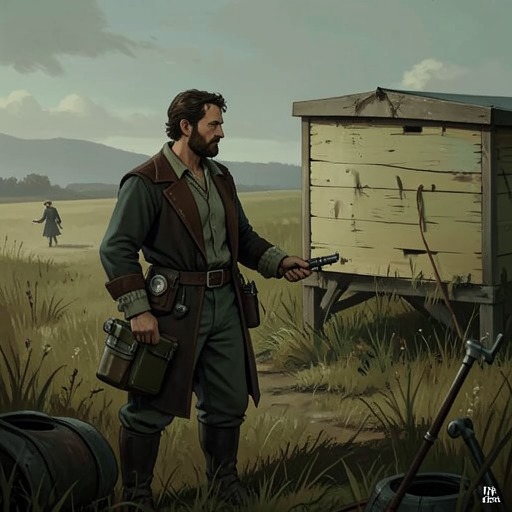
Sergeyich belongs to a community the author describes as accustomed to being almost faceless: people formed by the mines and industrial plants of Donbas, once proud of their unobtrusive place in the Soviet “great industrial whole.” The novel introduces him not through a grand declaration but through work and cold. At about three in the morning, he wakes to find the potbelly stove in his home has gone out and the two buckets beside it are empty. Wearing slippers fashioned from an old pair of felt boots and a sheepskin coat, he goes outside to fetch coal. This small task establishes the material scale of his days: comfort is improvised, warmth must be maintained, and ordinary life continues amid a landscape shaped by war.
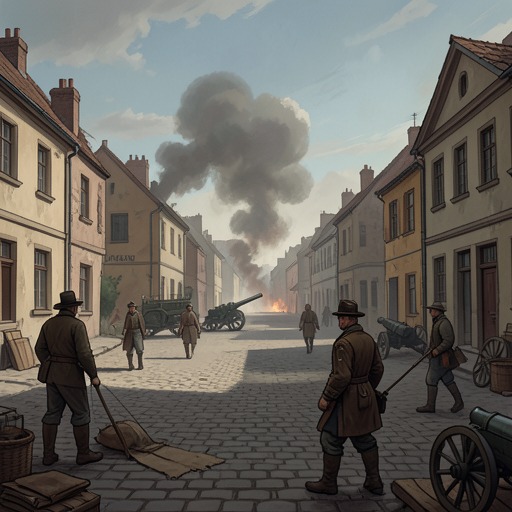
The village around him has been quiet for two weeks, but quiet does not mean safety. Ukrainian forces occupy trenches on a rise beyond the fields; armed men associated with the separatists and Russian military are positioned beyond the other side of the village. The fighting has emptied Little Starhorodivka, leaving Sergeyich and Pashka as its last two residents. Sergeyich has not been driven out by fear for his life. Instead, the war has left him confused and indifferent to much of what surrounds him, as if his senses have narrowed to one continuing obligation: his bees.
That obligation is concrete, seasonal work. During winter, the hives are in the shed, lined with felt and covered with sheets of metal. Sergeyich knows a shell might come from either direction and wonders whether its shrapnel could pierce the metal, then whether it would also break through the wooden walls. The thought does not make him abandon the hives. It shows how thoroughly the war has entered his practical calculations, even as he measures danger by what it might do to the bees.
Names, memory, and private attachments
Sergeyich’s own name carries the divided identity of a borderland. When he meets the Ukrainian soldier Petro, he explains that his passport gives his name as Serhiy Serhiyovych, while he calls himself Sergey Sergeyich. Petro, whose passport says Petro rather than Peter, understands the distinction as a difference between official naming and personal choice. Sergeyich is neither simply detached from Ukraine nor reducible to the Russian identity others assign him. In Crimea, when asked to approach the Russian security service on behalf of Akhtem’s family because he is supposedly “one of their own,” he quietly insists that he is Ukrainian.
His memories of family life arrive through domestic objects and altered scenes. A dream revises Vitalina’s first walk through the village in her red ant-pattern dress. In the remembered reality, Sergeyich was too embarrassed to walk beside her; she proceeded alone, drawing the neighbours’ attention, and the dress made her the subject of village gossip. In the dream, he walks beside her and greets those same neighbours while their gaze remains fixed on the dress. The altered memory grants him, belatedly, the public companionship he failed to offer at the time. His recollection also acknowledges that the marriage did not last as long as he hoped.
At Nastasya’s table, the taste of borscht opens another register of memory. Dumplings are absent, as he expected: his childhood love of them belongs to an earlier time, while his taste for borscht developed after his wedding. He thinks of the past preserved in school, military, and wedding photographs in albums on his sideboard. Memory, he reflects, withers and breaks apart while photographs remain. The meal makes loss palpable without turning it into a dramatic revelation; domestic history persists as images, habits, and tastes that no longer belong to the present in the same way.
The beekeeper’s work and its meanings
For Sergeyich, beekeeping is not merely a livelihood or a symbol. He regards himself as the representative of his bees’ legitimate interests, while recognizing that their own purposes are gathering nectar and pollen. Their internal relations, including the everyday business of workers and drones, are theirs to manage. He does not imagine that they need his advice or permission. His responsibility is to watch their health, drive wasps from the hives, uncap honeycombs with a metal scraper, and collect honey, wax, and pollen. The queens live, reproduce, and die according to nature, with successors born in the same hives.
This division of responsibility gives the work its peculiar balance. Most of the labour is done by the bees; Sergeyich’s life’s meaning nevertheless grows out of attending to them. The ringing of their wings proves not only that the apiary is alive, but, to him, that he is present too. Their survival becomes a modest counterweight to the numbness surrounding him, an everyday form of attention in a place where human life has been uprooted and violence has become ordinary.
When it is time to leave Donbas, that care dictates the logistics of departure. He plans to close the hive entrances so the bees will not scatter, load the hives one by one onto a flatbed trailer, protect them with a tarpaulin, and strap them down. He also packs a dozen jars of honey. Honey, he reasons, retains its value more reliably than sausages or clothing, rather like the dollar. Weather matters just as much as money: at around ten degrees, rain will cool the hives, while warmer conditions would require him to travel at night because bumpy roads agitate the bees and raise the temperature inside. His journey is therefore not an abstract escape but a transport problem in which the bees’ bodies and needs determine the route’s practical conditions.
In Crimea, his work acquires a new vulnerability. The authorities eventually take one hive for tests, saying the bees have not received the required health clearance and might transmit disease to local bees. Official procedure turns his living companions into a possible threat to be inspected and removed. The episode sharpens the contrast between Sergeyich’s close knowledge of his hives and the state’s power to interrupt their care through regulation and force.
Crimea: sympathy and the limits of neutrality
Sergeyich travels south hoping to arrange a proper holiday for his bees, but the sojourn becomes an ordeal. He is welcomed by Aisylu, who helps him place his hives near Akhtem’s apiary and gives him the key to a tool shed, with a spring about three hundred metres away. His gratitude is intimate and unguarded. Once settled, he asks whether the police have looked for Akhtem. Aisylu answers that Cossacks took him; she has heard that he may have been sent to Russia. Three people disappeared after travelling together to the mosque in Bakhchysarai. Their car was found empty, and a child reportedly saw them forced into a minibus.
Aisylu later asks Sergeyich to go to the Federal Security Service in Simferopol and ask about Akhtem. She believes the officials will speak to a Russian from Donbas, whereas they would turn her away. The request makes his assigned identity dangerous as well as useful: she appeals to the belonging others attribute to him, but he answers that he is Ukrainian. He is physically frightened, his face seeming to stiffen, yet the fear begins to pass as he sits with the family’s expectation directed toward him. His decision to act does not erase that fear; it marks the moment when keeping to himself ceases to be enough.
At the security service, Ivan Fyodorovich tells him that he is a foreigner who has been admitted to Russia for humanitarian reasons, along with his bees. He warns Sergeyich to watch his words and says that he may stay no longer than ninety days. On Akhtem, he directs the family to the police and suggests the case concerns either Crimean Self-Defence or the Cossacks. The conversation exposes the coercive terms beneath Sergeyich’s apparent refuge: permission to remain is presented as a favour, and gratitude is invoked to constrain what he can say. He responds that he keeps quiet and only looks after his bees, but the novel has already shown that his concern for Aisylu’s family makes silence morally difficult.
That conflict is not resolved by a single brave gesture. Sergeyich’s willingness to seek information risks drawing suspicion from the security service, while his presence in Crimea depends on the same authorities whose conduct troubles him. His position is both marginal and exposed: an outsider from a war zone, admitted with his apiary on humanitarian grounds, but treated as someone who must not mistake that admission for freedom to speak.
Care, departure, and the ending
The relationships Sergeyich forms are often expressed through practical help. Aisylu entrusts him with access to Akhtem’s tools and asks him to inquire about her missing husband. Later she gives him a plan for helping Aisha cross into Ukraine: on Wednesday, when the border queues are shorter, he can drive her to the exit; she will pass through the Russian and Ukrainian controls on foot, and he can collect her on the Ukrainian side. Sergeyich agrees, then says that he will need help getting his hives onto the trailer. The exchange places his own practical dependence beside his readiness to help. Care moves in both directions, through keys, directions, transport, and assistance with the load.
When a swarm begins to gather on a pear tree, he works to keep it from escaping. He mists the bees with water from a flask, weighing down their wings until their buzzing quiets, then climbs two rungs of a ladder with the trap held between his stomach and the tree. He sweeps the swarm into it in two trembling clusters. Nearly a hundred bees remain on the trunk, but they crawl down after the others, unwilling to be left without their queen. Sergeyich watches them descend and raises the trap to make their return easier. The scene gives the bees their own collective movement and need, while showing his expertise as careful attention rather than command.
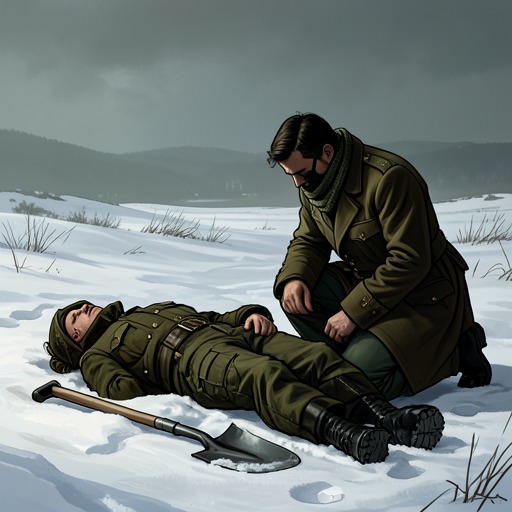
The most violent reversal comes when Sergeyich finds a grenade in a hive and uses it against the grey bees. After the blast, he presses his face into the dry black earth. He hears a whistle and buzzing above him, feels something wet land on the back of his head, and struggles to breathe with his mouth against the ground. When the thunder passes, ringing silence takes its place. He rises unsteadily. The third hive is gone; only a crater, fragments of wood, a piece of comb, and a passing bee remain. The destruction reduces a structure he has tended to scattered material and a survivor in motion. His life’s central object, which had held his attention through the war and carried him across the border, is not invulnerable to the violence around it.
Sergeyich’s significance lies in this contradiction. He is neither an untouched bystander nor a conventional combatant, but a man whose labour keeps him attentive to lives beyond his own while the surrounding authorities and armed forces press people into fixed identities and silences. The bees are real dependants with their own needs, not simply an emblem for human suffering; yet their care also makes visible what war threatens: the fragile continuities of home, work, mutual reliance, and return. The journey that begins as a beekeeper’s search for a suitable place for his hives ends with that ordinary care tested by political power and finally by explosive force.